Cuyahoga's 2027 value update is coming. Here's what 2024's jump, and today's sales, suggest.
ACC Insights · November 18, 2026
Key findings
- Cuyahoga County's next mid-cycle "triennial update" is tax year 2027, with taxes collected in 2028. The Ohio Department of Taxation's 2026-2031 schedule lists Cuyahoga as a 2027 update county. The county's May 15, 2026 Annual Information Statement says the same.
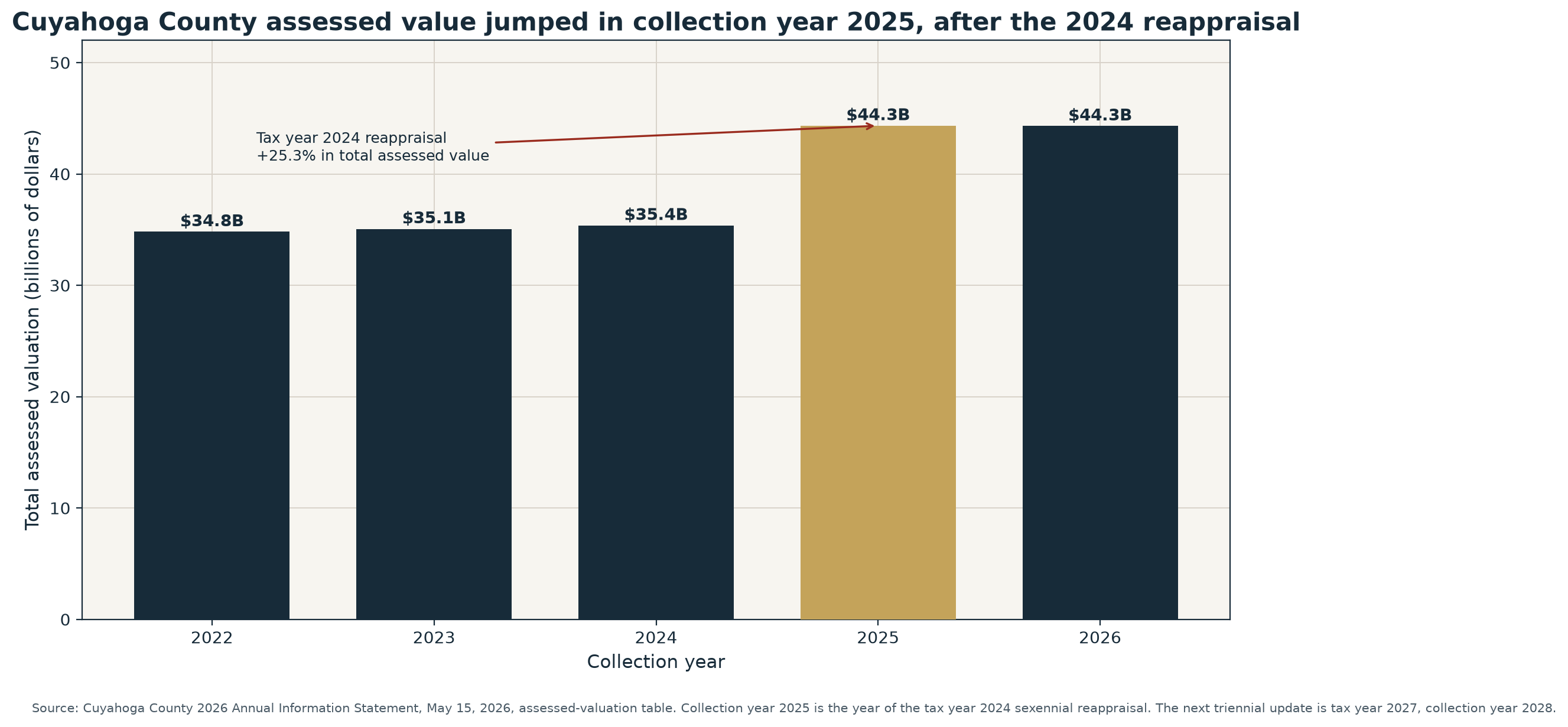
- The last full reappraisal, tax year 2024 / collection year 2025, raised certified property values by about 25% countywide, according to that same official statement. The county's July 9, 2024 announcement of proposed results put the average increase in home values at 32%, with a range from 15% in Hunting Valley to 67% in East Cleveland. Those July figures were proposed and pending state approval. The later 25% figure is the certified, countywide result for property values as a whole.
- A higher value does not raise the tax bill one-for-one. Ohio's House Bill 920 reduction factors are designed to keep revenue from most voted levies from rising automatically when values rise. Inside (unvoted) millage and new levies can still move a bill. Beginning in tax year 2026, a later change described in the county's 2026 statement can also limit inside-millage revenue growth in a reappraisal or update year.
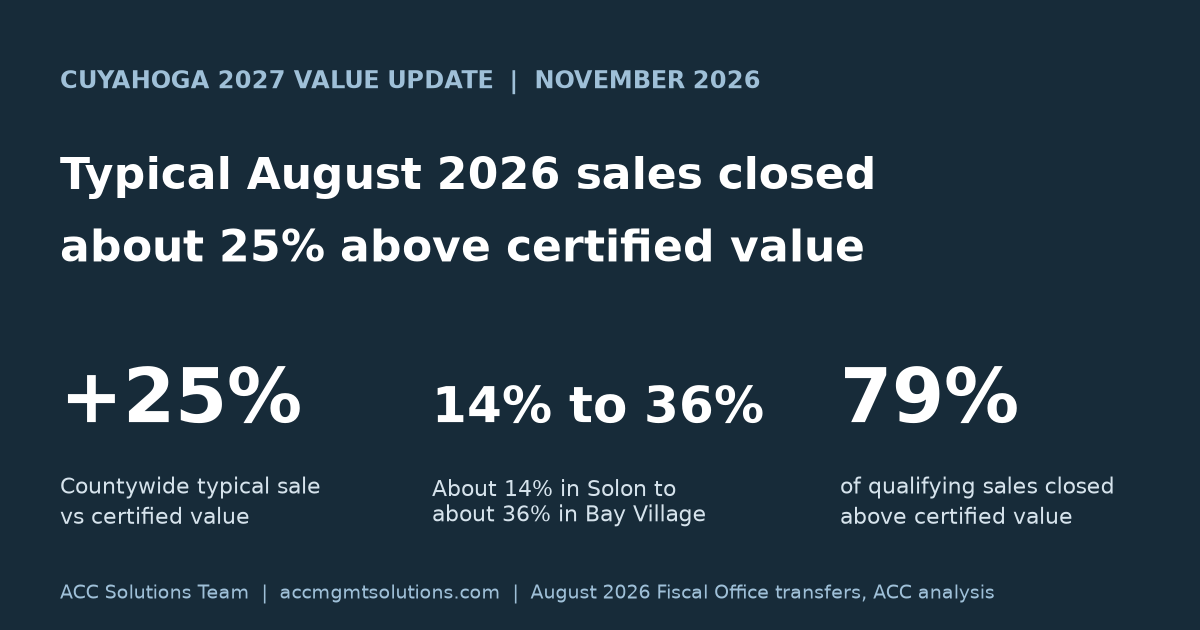
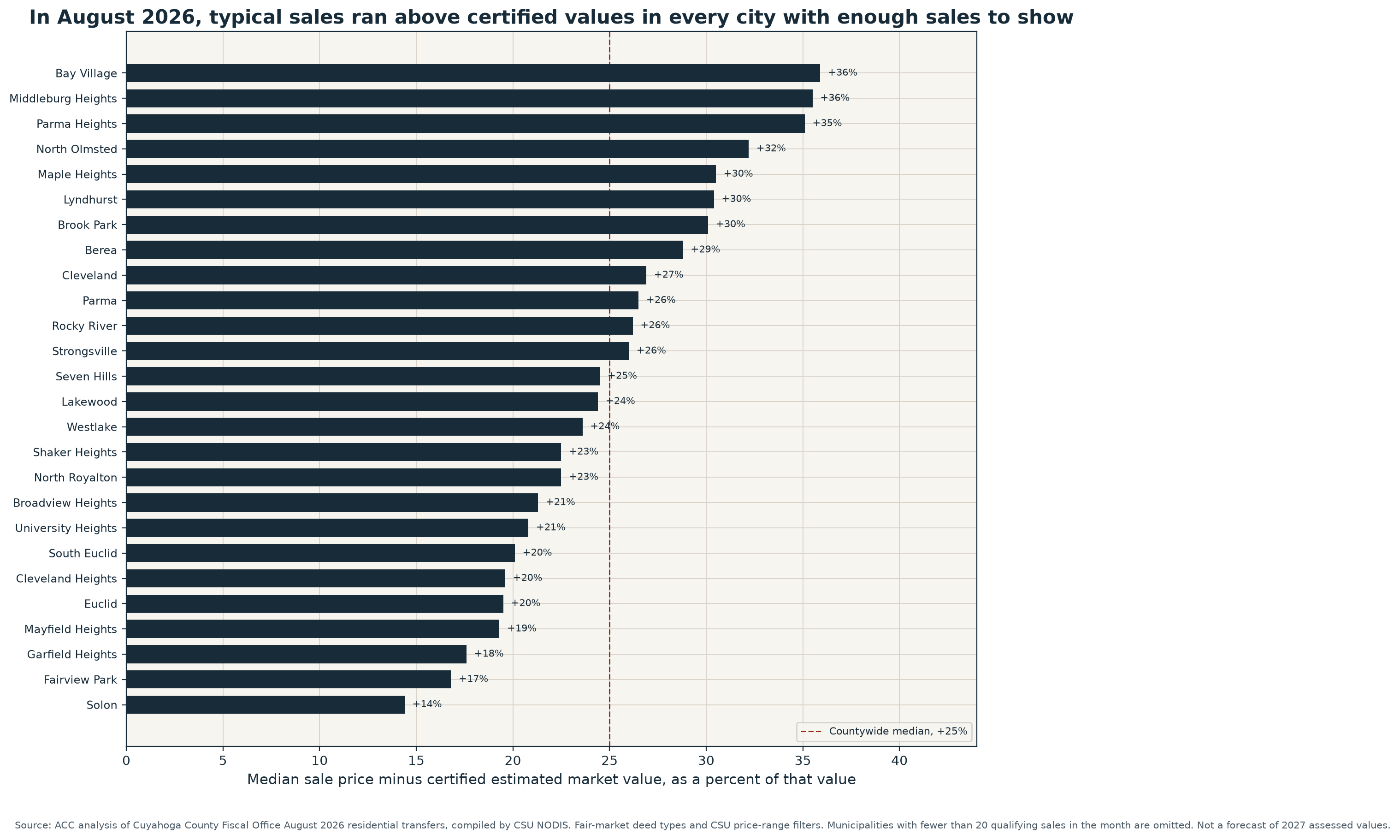
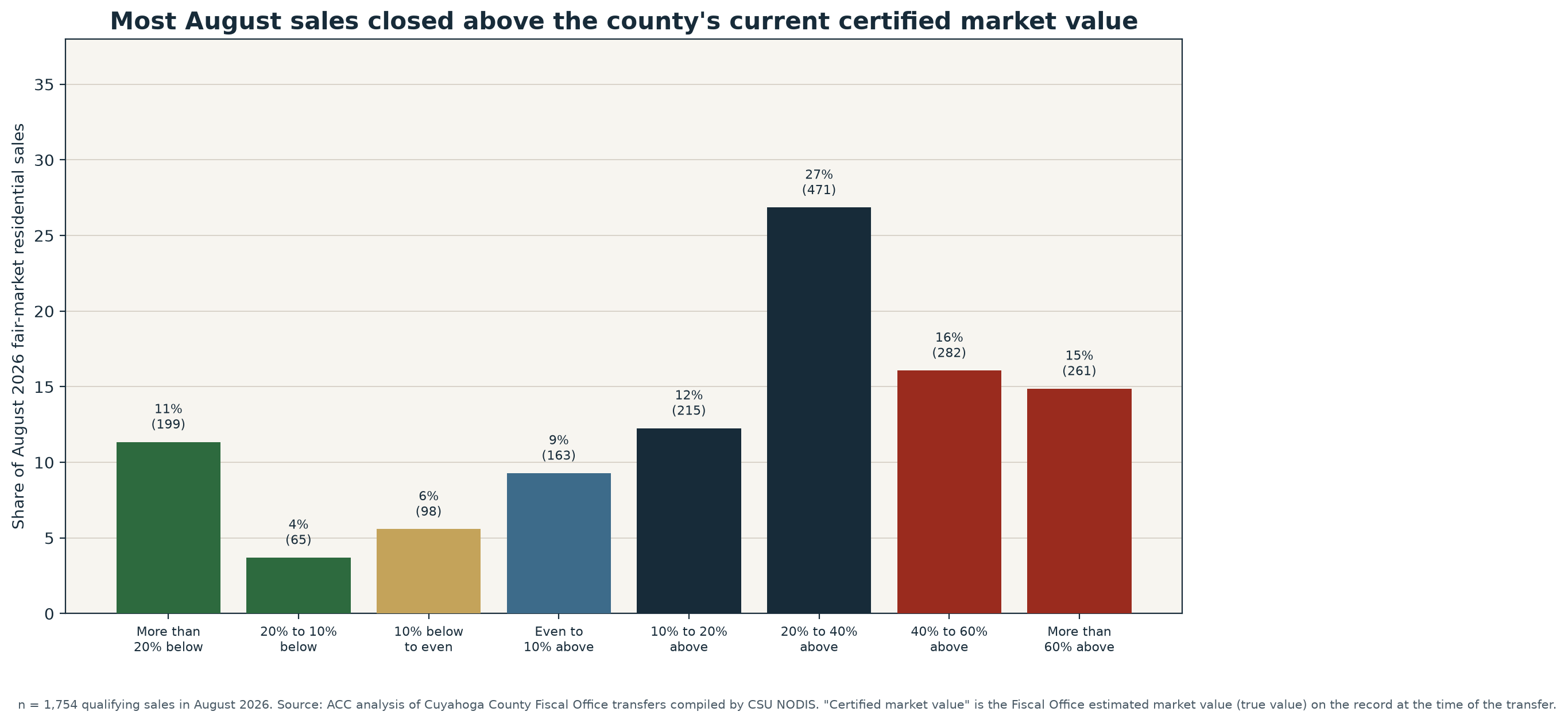
- Today's sales already run above the values on the books. In August 2026, the latest month for which complete Fiscal Office transfer files were available, the median fair-market residential sale in Cuyahoga County was $205,000, while the median certified estimated market value on those same records was $166,500. The typical sale closed about 25% above the certified value. About 79% of qualifying sales closed above the certified value, and about 70% closed more than 10% above it. That was true in every municipality with at least 20 qualifying sales that month, with typical premiums from about 14% in Solon to about 36% in Bay Village.
- That is a signal, not a forecast of a 25% countywide increase in 2027. The triennial update adjusts values using sales-to-assessment ratios over a three-year period, and it is done by municipality and neighborhood, not with one countywide factor. Some areas will move more than others. Some parcels will move less, or not at all, if the sales do not support it.
- Separate from the update, market prices are still rising modestly. The median one-family sale in Cuyahoga County, year to date through August 2026, was $220,100, compared with $205,000 through August 2025, according to Cleveland State University's compilations of Fiscal Office transfers, an increase of about 7.4%. Redfin's median for the three months ending October 2026 was $234,212, up 8.9% from a year earlier.
What the 2027 update is, and what it is not
Ohio law requires a full, parcel-by-parcel sexennial reappraisal every six years, and a statistical update in the third year. Cuyahoga completed the full reappraisal in tax year 2024 (bills collected in 2025). The next update is tax year 2027 (bills collected in 2028).
The county's official description is plain. The sexennial reappraisal is done by individual appraisal. The triennial update is done "without individual appraisal of properties, but with reference to a sales-assessment ratio over the three-year period." In the Fiscal Office's 2024 overview, that work is described as trending values with ratio studies by municipality, neighborhood, and neighborhood groups, by comparing sale prices with the current certified value.
In September 2026 the Fiscal Office used camera-equipped vehicles to collect street-level imagery for the 2027 update. County officials said the photos help appraisers verify condition and recent sales remotely. They also said the imagery does not set the market. "The appraisal office does not set the values as far as what the market is doing, the sales are what sets the market," Lou Gentile, the county's commercial appraisal manager, told Cleveland19 on September 3, 2026.
The next full reappraisal is later. The Ohio Department of Taxation's schedule dated February 4, 2026, lists Cuyahoga for a sexennial reappraisal in 2031. The county's 2026 Annual Information Statement explains that in January 2026 the state delayed the sexennial reappraisal of 16 counties by one tax year, and that Cuyahoga's next full reappraisal moved to tax year 2031, collection year 2032. (A footnote in the same statement's valuation table still says tax year 2030 / collection year 2031. We follow the detailed narrative and the state's published schedule.)
What happened in 2024, in official numbers
Two official figures get used, and they are not the same number.
On July 9, 2024, the county announced proposed results of the state-ordered reappraisal, pending Ohio's approval: "an average increase of 32% in home values across Cuyahoga County, ranging from 15% in Hunting Valley to 67% in East Cleveland." The same release said an increase in valuation "does not necessarily mean property taxes will increase," and that many owners would still see higher bills.
The county's Annual Information Statement dated May 15, 2026, looking back at the certified result, says: "The County property values increased by approximately 25% on average throughout the County." It also recaps earlier cycles: values rose 9.5% in the 2018 reappraisal, 13.1% in the 2021 update, and 25% in 2024.
The statement's assessed-valuation table matches that story. Total assessed valuation was $35.371 billion in collection year 2024 and $44.330 billion in collection year 2025, an increase of 25.3%. Real estate assessed value rose from $33.754 billion to $42.557 billion, or 26.1%. Collection year 2026 was essentially flat at $44.304 billion, which is what you would expect in a year with no reappraisal or update.
The 32% figure was the proposed average for homes. The 25% figure is the certified, countywide average for property values. Both can be true. Commercial and other classes pulled the overall average down from the residential proposed figure, and proposed notices can change before certification.
Why a higher value is not a matching tax increase: House Bill 920
Ohio taxes real property on 35% of appraised (true) value. One mill is $1 of tax per $1,000 of that assessed value. If every levy were a simple unvoted rate, a 25% value increase would produce a 25% tax increase. That is not how most of an Ohio tax bill works.
In 1976, the General Assembly enacted House Bill 920. The Fiscal Office's 2024 overview puts it this way: the law "authorized adjustments that reduce millage rates to keep increased property valuations from producing 'windfall' revenues for taxing districts." Voted levies are the ones that get those reduction factors. When values go up, the effective rate on those levies is reduced so that the levy still raises about what voters approved, plus new construction.
The Ohio Department of Taxation's real-property FAQ makes the same point: increases in property values "do NOT mean that the corresponding property taxes will increase proportionally," and "Generally, tax bills will remain constant even though the property value may have increased or decreased. Tax bills may see modest increases based on inside millage, new levies, or even new construction."
Three practical limits matter for 2027:
- Inside millage, the unvoted rate of up to 10 mills, does move with value unless a later law constrains it. The county's 2026 statement describes Substitute House Bill 335, beginning with tax year 2026: in a county's reappraisal or update year, budget commissions must adjust inside millage so that any revenue increase is limited to GDP-deflator growth over the prior three years, with a process for a taxing unit to request more. We are summarizing the county's description, not offering a legal opinion. The point for owners is that the old rule of thumb, "inside millage will fully follow the value increase," may not apply in a straight line in 2027.
- New levies, replacement levies, and special assessments can raise a bill even when reduction factors hold the older voted rates down.
- Credits such as the homestead exemption and the owner-occupancy credit can change a residential bill. Investment properties do not get the owner-occupancy credit.
The county also said, after the 2024 cycle, that many owners would see higher bills even with those guardrails. That can happen when inside millage, new levies, or a value increase that is larger than the neighborhood average all land on the same parcel.
What current sales say about the values on the books
If the 2027 update is a sales-to-assessment exercise, the useful question is not "what will the county announce?" It is "how do recent arm's-length sales compare with the values already certified after 2024?"
We analyzed the August 2026 residential transfer files that Cleveland State University's Northern Ohio Data and Information Service compiles each month from the Cuyahoga County Fiscal Office. We followed CSU's documented filters: deed types that CSU treats as fair-market transfers (including warranty, survivorship, fiduciary, and sheriff deeds, and excluding quitclaims), residential uses (single-family, two-family, three-family, and condos), exclusion of multi-parcel combined sales, and CSU's sale-price range relative to estimated market value (for most homes, at least the assessed value and less than six times estimated market value; for condos, $25,000 to $2 million). Cleveland sales come from CSU's Cleveland SPA file. Suburban sales come from the suburbs file. We did not publish addresses, parcel numbers, or buyer or seller names.
After those filters, 1,754 August sales remain. The median conveyance price was $205,000. The median certified estimated market value on the same records was $166,500. The median sale was 25.0% above the certified value. About 79% of the sales closed above the certified value, and about 70% closed more than 10% above it.
The pattern was broad. In the City of Cleveland (532 qualifying sales), the median sale was $118,000, about 27% above certified value. In the suburbs (1,222 sales), the median sale was $260,000, about 24% above certified value. Every municipality with at least 20 qualifying sales in August had a median sale above its median certified value, with typical premiums from about 14% (Solon) to about 36% (Bay Village and Middleburg Heights). Parma, with 140 sales, was about 26% above. Lakewood, with 69 sales, was about 24% above. Cleveland Heights, with 82 sales, was about 20% above.
A one-month snapshot is not a three-year ratio study. August includes whatever closed that month, and sheriff and fiduciary deeds are in CSU's fair-market list (41 sheriff sales were in the 1,754). If we limit the set to warranty and survivorship deeds only, the median sale is $209,000 and the median premium is about 27%, so the conclusion does not hang on those other deed types. The 2027 update will use three years of sales, cut by municipality and neighborhood. Areas that have cooled, or that already saw large 2024 increases, may get a smaller factor than areas where sales have kept running ahead.
We also cannot see September or October Fiscal Office microdata in the same complete form. CSU's year-to-date one-family summaries, which do include those earlier months of 2026, show the median one-family sale through August 2026 at $220,100, up from $205,000 through August 2025. Redfin, using MLS and public records, puts the median for the three months ending October 2026 at $234,212, up 8.9% year over year. Both say the market has moved up since the 2024 values were set, and neither is a substitute for the county's official ratio study.
What this means for you
If you own your home in Cuyahoga County
Plan for a new official value in tax year 2027, with the effect showing up on bills collected in 2028. Do not assume the bill will rise by the same percentage as the value. Check last year's bill for the effective rate, any new levy, and whether you receive the homestead or owner-occupancy credit. When proposed or certified values go out, compare them with recent nearby sales and with what you paid, if the purchase was recent. If the value looks wrong, the Board of Revision is the formal path to challenge it. After the 2024 reappraisal, formal complaints were accepted from January 1 through March 31, 2025. For 2027, confirm the filing window with the Board of Revision when the county publishes it. Informal review, if the county offers it again, usually comes first.
If you are a landlord or you hold rentals
Taxes are a holding cost. Underwrite 2028 collection using a higher value than the 2024 certified number if recent sales in that city are running above the books, and then apply a conservative effective-rate assumption rather than multiplying today's tax bill by the full sales premium. Tenant-occupied property does not get the owner-occupancy credit. If a building sold recently for well above the certified value, expect the update, or a new owner's bill, to take notice of that sale. Budget for a Board of Revision filing if the new value is out of line with the condition of the property or with comparable sales.
If you are buying from out of state, or buying with cash or crypto
Ask for the current certified value, the most recent tax bill, and the tax rate card for that municipality, and treat 2028 as a year when the value may be reset. A purchase price above the certified value is information the county can use. It is not, by itself, the 2028 tax bill. Build a range: today's bill, and a higher bill if inside millage and any new levies move, rather than a single number. ACC can help with property management, rehab, and closings in Cuyahoga County, including paying in Bitcoin or Ethereum. We do not set values, file tax complaints as counsel, or promise a tax result. Call (216) 238-5999.
If you are deciding whether to challenge a value
The county's 2024 guidance still holds as a method: evidence matters. Useful documents include a recent appraisal, a closing statement, photos of condition, and contractor estimates for needed work. A Board of Revision decision from an earlier year does not automatically carry forward through a later reappraisal, the Fiscal Office has said. Filing dates and forms come from the Board of Revision, not from this article.
Methodology, in brief
Official schedule and 2024 value-change figures are quoted from the Cuyahoga County 2026 Annual Information Statement (May 15, 2026), the county's July 9, 2024 news release, the Ohio Department of Taxation reappraisal and update schedule (revised February 4, 2026), and the Fiscal Office's 2024 Sexennial Reappraisal Overview. House Bill 920 and the tax-calculation explanation come from the Ohio Department of Taxation FAQ, the Fiscal Office overview, the County Treasurer's tax-calculation page, and the 2026 statement's discussion of reduction factors and Substitute House Bill 335.
The August 2026 sales analysis uses CSU NODIS compilations of Fiscal Office residential transfers (Cleveland SPA individual file and suburbs individual file for August 2026), with CSU's published deed, use, and price-range filters applied by ACC. We report only medians, percentages, and counts, and we omit municipalities with fewer than 20 qualifying sales in the month. Year-to-date one-family medians are CSU's published "Total: Cuyahoga County, One Family" lines. Redfin's October 2026 median is cited as a later, separately computed market median.
A fuller method note and the publishable aggregate tables sit with this article.
Sources
- Cuyahoga County, 2026 Annual Information Statement, May 15, 2026. https://cuyahogacms.blob.core.windows.net/home/docs/default-source/fiscal-library/obm/annual-information-statements/2026annualinformationstatement.pdf
- Cuyahoga County, "Cuyahoga County Announces Proposed Results of Sexennial Property Reappraisal," July 9, 2024. https://cuyahogacounty.gov/county-news/county-news-detail/2024/07/09/cuyahoga-county-announces-proposed-results-of-sexennial-property-reappraisal
- Ohio Department of Taxation, "Year of Sexennial Reappraisal and Triennial Update 2026-2031," revised February 4, 2026. https://dam.assets.ohio.gov/image/upload/tax.ohio.gov/real_estate/yearofsexennialreappraisalandupdate-2026-2031.pdf
- Cuyahoga County Fiscal Officer, "2024 Sexennial Reappraisal Overview." https://cuyahogacounty.gov/docs/default-source/fiscal-library/2024sexennialreappraisalpresentation.pdf
- Cuyahoga County Fiscal Officer, 2024 Sexennial Reappraisal page (including the statement that an increase in valuation does not mean taxes will increase). https://cuyahogacounty.gov/fiscal-officer/2024-sexennial-reappraisal
- Ohio Department of Taxation, "Real Property Tax - General" FAQ. https://tax.ohio.gov/help-center/faqs/real-property-tax-general
- Cuyahoga County Treasurer, "Tax Calculation Explanation." https://cuyahogacounty.gov/treasury/pay-your-taxes/tax-increase-explanation
- Cleveland19, "Cuyahoga County deploys camera-equipped cars to update property records," September 3, 2026. https://www.cleveland19.com/2026/09/03/cuyahoga-county-deploys-camera-equipped-cars-update-property-records/
- Cleveland State University, Levin College, Cuyahoga County Fiscal Office Tables: Residential Sales Summaries by Municipality, and Residential Transfers (August 2026 files and year-to-date summaries). https://levin.csuohio.edu/neomdr/cuyahoga-county-fiscal-office-tables-residential-sales-summaries-municipality https://levin.csuohio.edu/neomdr/cuyahoga-county-fiscal-office-tables-residential-transfers
- Redfin, Cuyahoga County, OH Housing Market, as of October 2026. https://www.redfin.com/county/2177/OH/Cuyahoga-County/housing-market
Questions about ACC's Cleveland property management or rehab work: (216) 238-5999.
